Dali Man
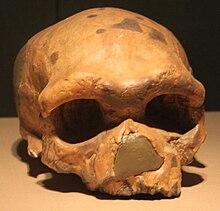 | |
| Common name | Dali Skull |
|---|---|
| Species | late Homo erectus, Homo heidelbergensis, or early Homo sapiens |
| Age | 260±20 ka |
| Place discovered | Dali County, Shaanxi, China |
| Date discovered | 1978 |
| Discovered by | Liu Shuntang |
The Dali Man (Chinese: 大荔人) is a extinct human relative that was found in China in 1978. Its exact placement in the human genus is argued over by scientists, some theories include it being a later member of homo erectus, an early modern human, or a part of its own species Homo daliensis.[1][2] The exact dating of the Dali Man is also subject to debate.
Taxonomy
The skull has a large brow-ridge that curves over each eye; unlike the straight brow-ridges of the Peking Man.[3] During fossilization the upper jaw was damaged and dislocated upwards, making the face look shorter then expected.[4]
References
- ↑ Wu, X. Z. (1981). "A well-preserved cranium of an archaic type of early Homo sapiens from Dali, China". Scientia Sinica. 24 (4): 530–41. PMID 6789450.
- ↑ Wu, X. Z. (1981). "A well-preserved cranium of an archaic type of early Homo sapiens from Dali, China". Scientia Sinica. 24 (4): 530–41. PMID 6789450.
- ↑ Wu, X. Z. (1981). "A well-preserved cranium of an archaic type of early Homo sapiens from Dali, China". Scientia Sinica. 24 (4): 530–41. PMID 6789450.
- ↑ Wu R. (1988): The reconstruction of the fossil human skull from Jinniushan, Yinkou, Liaoning Province and its main features. Acta Anthropologica Sinica no 7: pp 97–101.
