Gulf War Date August 2, 1990 – February 28, 1991 Location Result
Indecisive
Iraqi forces expelled from Kuwait
Kuwaiti monarchy restored
Destruction of Iraqi and Kuwaiti infrastructure
Coalition forces fail to advance past the Iraq-Kuwait border into southern Iraq
Iraq launches missiles against Saudi Arabian targets
Iraqi rocket attacks on Israel
Failed Shia/Kurdish uprisings against the Iraqi government
Iraqi Kurdistan obtains autonomy, establishment of the northern Iraq no fly zone by the USSaddam Hussein of the Ba'athist government retains power in IraqUN sanctions against Iraq maintained until 2003
United Nations Security Council Resolution 687 establishes cease-fire terms, beginning of the Iraq disarmament controversies
Belligerents
Kuwait United States United Kingdom Saudi Arabia Egypt Lebanon Jordan France Syria Morocco Oman Pakistan Canada United Arab Emirates Qatar Bangladesh Italy Australia Netherlands Niger Sweden Argentina Senegal Spain Bahrain Belgium Poland South Korea Norway Czechoslovakia Greece Denmark New Zealand Hungary
Diplomatic support :
Iran
Soviet Union
Iraq Commanders and leaders
Norman Schwarzkopf Jr.
Saddam Hussein Strength
956,600, including 700,000 US troops[ 1] [ 2]
650,000 soldiers Casualties and losses
Military dead: 1,000–2,000
Civilian dead: 500–1,000
Military dead: 80,000–100,000
Civilian dead: 5,000–7,000
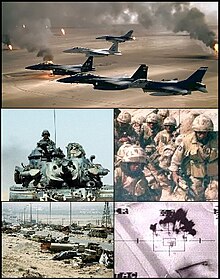
The Gulf War was a conflict between Iraq and 39 other countries, led by the United States . It started with the invasion of Kuwait by Iraq on August 2, 1990. Iraq had claimed Kuwait as part of its territory. Iraq is said to have suffered around 80,000-100,000 soldier losses.[ 3]
There were two military operations.
Operation Desert Shield brought troops to protect Dhahran, Saudi Arabia and the Gulf states that Iraq had not attacked.
Operation Desert Storm attacked Iraq's forces both in Kuwait and in Iraq. It started on 17 January, 1991 with an air strike. Ground operations started 24 February. Iraqi forces set fire to oil wells to slow the attack. The war ended on 28 February, 1991 with a ceasefire .[ 4]
The long Iran–Iraq War had ended in August 1988. Iraq owed a great amount of money to Saudi Arabia and had difficulty paying it back. Saddam Hussein declared the neighboring country of Kuwait to be siphoning Iraqi crude oil from across the border, and on August 2nd, 1990 the Iraqi invasion of Kuwait started. On January 17, 1991 the US began the Persian Gulf War with a massive US led air offensive known as Operation Desert Storm.[ 5]
The attacks were assisted by newly developed weapons, including stealth aircraft , cruise missiles and smart bombs .
After 42 days of fighting U.S. President Bush declared a ceasefire on February 28. By that time most Iraqi forces in Kuwait had either surrendered or fled.
Operation Desert storm included a bombing campaign that targeted Iraqi aircraft, anti-aircraft systems, oil refineries, weapon factories, bridges, and roads. President George Bush decided not to depose Saddam Hussein.
Political issues after Operation Desert Storm lead to the second Persian Gulf War in 2003.
Medal for United States personnel.
Related pages
References
Wikimedia Commons has media related to
Gulf War .
Beginning of the Iraqi conflict
Prelude
Background
Rationale
WMD claims
Yellowcake uranium
Aluminum tubes
Biological weapons
Chemical weapons
"Curveball"
Mobile weapon labs
Saddam–al-Qaeda conspiracy theory
Oil as a possible rationale Issues
American imperialism
Colin Powell's UN presentation
Disarmament crisis
Failed peace initiatives
Iraq resolution / UK parliament's support for invasion
Iraqi–Kurdish conflict
Legality
Legitimacy of the invasion
Media coverage
Military analyst program
Rapid response operation
Saddam's alleged shredder
Preemptive war Saddam Hussein and human rights Dossiers
Habbush letter
Downing Street memo
September Dossier
Vilnius letter
Letter of the eight Bush–Blair 2003 memo
February Dossier
Bush–Aznar memo
Overview
Key events Invasion
Timeline
Preparations for invasion
Multi-National Force
Battle of Nasiriyah
Fall of Baghdad
Battle of Debecka Pass
Firdos Square statue
Mission Accomplished speech
US public opinion Occupation(2003–2011)
Occupation of Ramadi
De-Ba'athification
100 Orders
CPA Order 2
CPA Order 17
U.S. military bases
Blackwater
Reconstruction
Economic reform
UNAMI
Al Qa'qaa high explosives
U.S. kill or capture strategy Replacementgovernments
Coalition Provisional Authority
Interim Government
2005 parliamentary elections
Transitional Government
Constitution
Participants
Countries
Australia
Ba'athist Iraq
Denmark
Georgia
Iran
Italy
Japan
Poland
South Korea
Thailand
Ukraine
United Kingdom
United States Insurgent
Sunni Shia
Mahdi Army
Abu Deraa's militia
Badr Organization
Islamic Supreme Council of Iraq
Sheibani Network
Soldiers of Heaven
Asa'ib Ahl al-Haq
Promised Day Brigade
Kata'ib Hezbollah Ba'ath
Fedayeen Saddam Al-Awda
Popular Army
Al-Abud Network
Army of the Men of the Naqshbandi Order
Supreme Command for Jihad and Liberation
Impact
General
Casualties
Iraq Body Count
Iraq Family Health Survey
Lancet surveys
ORB survey
Damage to Baghdad
Al-Aimmah Bridge disaster
Human rights
Humanitarian crisis
Financial cost
Refugees
Iraqi Christians
Mandaeans
Violence against Iraqi academics Political
Post-invasion WMD conjecture
Iraq scandal in Finland
Dixie Chicks comments
Plame affair
Hood event
Death of David Kelly
Kidnapping of Angelo dela Cruz
2004 document leak
Al Jazeera bombing memo
Scott Thomas Beauchamp controversy
MoveOn.org ad controversy
Six Days in Fallujah Role of Canada
Reactions
Pre-war
Pre-war international reactions
Khuy Voyne! Saddam Hussein interview
Views on the invasion
Opposition
Criticism
United Nations
Oprah's Anti-war series
Iraqi map pendant
Winter Soldier: Iraq & Afghanistan
Photo Op
A Responsible Plan to End the War in Iraq Bush shoeing incident Protests
Halloween 2002
February 15, 2003 March 20, 2003
Bring Them Home Now Tour
January 20, 2005
September 24, 2005
January 27, 2007
March 17, 2007
2007 Port of Tacoma
September 15, 2007
March 19, 2008
Aftermath in Iraq
The rise of ISIL
Insurgency (2011–13)
War in Iraq (2013–17)War against ISIL (2014–present)
U.S.-led intervention in Iraq (2014–2021)
Insurgency (2017–present)
Miscellaneous
Terminology Critical
Global arrogance
Inverted totalitarianism
"The wrong war, at the wrong place, at the wrong time"
Memorials
Afghan–Iraqi Freedom Memorial (Salem, Oregon)
Al-Shaheed Monument
Iraq and Afghanistan Memorial (London)
Northwood Gratitude and Honor Memorial
Old North Memorial Garden
Saving Iraqi Culture Lists
Assassinations
Aviation shootdowns and accidents
Bombings
Coalition military operations
Documentaries
Iraqi security forces fatality reports
Most-wanted Iraqi playing cards
Private contractor deaths Timeline
2003
2004
2005
2006
2007
2008
2009
2010
2011
List of modern conflicts in the Middle East
1910s
Italo-Turkish War
World War I Unification of Saudi Arabia
Simko Shikak revolt
1919 Egyptian Revolution
Turkish War of Independence Greco-Turkish War
Turkish–Armenian War
Franco-Turkish War
Revolts Mahmud Barzanji revolts 1920s
Franco-Syrian War
Iraqi Revolt (1920)
Intercommunal conflict in Mandatory Palestine
Adwan Rebellion
Arab separatism in Khuzestan
Great Syrian Revolt
Sheikh Said rebellion 1930s
Ararat rebellion
Ahmed Barzani revolt
Simele massacre
Saudi–Yemeni War (1934)
Goharshad Mosque rebellion
1935–1936 Iraqi Shia revolts
1935 Yazidi revolt
1936–1939 Arab revolt in Palestine
Dersim rebellion 1940s
World War II Italian bombing of Palestine
Allied invasion of Iraq
Syria–Lebanon campaign
Anglo-Soviet invasion of Iran 1943 Barzani revolt
Alwaziri coup
Al-Wathbah uprising
Kurdish separatism in Iran
Arab–Israeli conflict 1950s 1960s
Cyprus crisis of 1963–1964
Iraqi–Kurdish conflict
First Iraqi–Kurdish War
Second Iraqi–Kurdish War Dhofar Rebellion
North Yemen Civil War Feb. 1963 Iraqi coup
Mar. 1963 Syrian coup
Nov. 1963 Iraqi coup
Aden Emergency
1964 Hama riot
Israeli–Palestinian conflict 1966 Syrian coup d'état 1970s
Black September in Jordan
Yemenite War of 1972
Turkish invasion of Cyprus
Shatt al-Arab clashes
Lebanese Civil War Political violence in Turkey
Islamist uprising in Syria
1977 Shia uprising in Iraq
NDF Rebellion
Yemenite War of 1979
Iranian Revolution
Consolidation of the Iranian Revolution 1979 Qatif Uprising
Grand Mosque seizure
1979–1980 Shia uprising in Iraq 1980s
Iran–Iraq War 1980 Turkish coup d'état Kurdish–Turkish conflict
South Yemen Civil War
1986 Egyptian conscripts riot
1986 Damascus bombings
1987 Sharjawi coup d'état attempt
Mecca massacre
Abu Nidal's executions 1990s
Gulf War (1990–1991) 1991 Iraqi uprisings
Terror campaign in Egypt (1990s)
Yemeni Civil War (1994)
Iraqi Kurdish Civil War
Islamic insurgency in Saudi Arabia (2000–present)
Operation Desert Fox
al-Qaeda insurgency in Yemen
1999 Shia uprising in Iraq 2000s
Iraq War Balochi insurgency in Iran 2004 Qamishli riots
Houthi insurgency in Yemen
Iran–Israel proxy conflict
Fatah–Hamas conflict South Yemen insurgency 2010s
2011 Bahraini uprising
Egyptian Crisis
Sinai insurgency Insurgency in Egypt (2013–present)
Syrian civil war Turkish involvement in Syria Syrian War spillover in Lebanon
Iraqi insurgency (2011–2013)
War in Iraq (2013–2017) Islamic State insurgency in Iraq (2017–present) Yemeni crisis
Yemeni civil war (2014–present) 2020s This list includes World War I and later conflicts (after 1914) of at least 100 fatalities each Prolonged conflicts are listed in the decade when initiated; ongoing conflicts are marked italic, and conflicts with +100,000 killed with bold.
 Soviet Union
 Iraq
Iraq Norman Schwarzkopf Jr.


