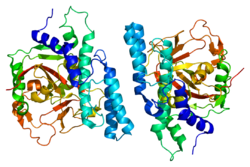
PARP1 Strwythurau PDB Human UniProt search: PDBe RCSB Rhestr o ddynodwyr PDB 1UK0 , 1UK1 , 1WOK , 2COK , 2CR9 , 2CS2 , 2DMJ , 2JVN , 2L30 , 2L31 , 2RCW , 2RD6 , 2RIQ , 3GJW , 3GN7 , 3L3L , 3L3M , 3OD8 , 3ODA , 3ODC , 3ODE , 4AV1 , 4DQY , 4GV7 , 4HHY , 4HHZ , 4L6S , 4OPX , 4OQA , 4OQB , 4PJT , 4UND , 4ZZZ , 5A00 , 4R5W , 4R6E , 4UXB , 2N8A , 4XHU , 4RV6 , 5HA9 , 5DS3
Dynodwyr Cyfenwau PARP1 Dynodwyr allanol OMIM: 173870 HomoloGene: 1222 GeneCards: PARP1 Ontoleg y genyn Gweithrediad moleciwlaidd • transferase activity • DNA binding • R-SMAD binding • DNA ligase (ATP) activity • protein N-terminus binding • glycosyltransferase activity • NAD binding • zinc ion binding • transcription factor binding • histone deacetylase binding • metal ion binding • GO:0001948, GO:0016582 protein binding • identical protein binding • protein kinase binding • estrogen receptor binding • enzyme binding • SMAD binding • RNA binding • NAD+ ADP-ribosyltransferase activity • protein ADP-ribosylase activity • RNA polymerase II transcription regulatory region sequence-specific DNA binding • GO:0001077, GO:0001212, GO:0001213, GO:0001211, GO:0001205 DNA-binding transcription activator activity, RNA polymerase II-specific • NAD DNA ADP-ribosyltransferase activity Cydrannau o'r gell • nuclear envelope • bilen • transcription regulator complex • nucleoplasm • nucleolus • mitocondria • cnewyllyn cell • protein-DNA complex • cytoplasm • GO:0009327 protein-containing complex • site of double-strand break • site of DNA damage • Cromosom Prosesau biolegol • positive regulation of transcription regulatory region DNA binding • lagging strand elongation • GO:0009373 regulation of transcription, DNA-templated • mitochondrial DNA metabolic process • mitochondrial DNA repair • nucleotide-excision repair, DNA damage recognition • mitochondrion organization • signal transduction involved in regulation of gene expression • protein autoprocessing • GO:1901227 negative regulation of transcription by RNA polymerase II • transcription by RNA polymerase II • macrophage differentiation • cellular response to DNA damage stimulus • positive regulation of cardiac muscle hypertrophy • global genome nucleotide-excision repair • double-strand break repair via homologous recombination • protein modification process • cellular response to insulin stimulus • negative regulation of telomere maintenance via telomere lengthening • protein poly-ADP-ribosylation • cellular response to oxidative stress • DNA ligation involved in DNA repair • nucleotide-excision repair, DNA incision • GO:0100026 DNA repair • positive regulation of SMAD protein signal transduction • nucleotide-excision repair, preincision complex assembly • regulation of oxidative stress-induced neuron intrinsic apoptotic signaling pathway • cellular response to zinc ion • regulation of SMAD protein complex assembly • cellular response to amyloid-beta • regulation of DNA methylation • positive regulation of mitochondrial depolarization • nucleotide-excision repair, DNA incision, 3'-to lesion • positive regulation of intracellular estrogen receptor signaling pathway • positive regulation of protein localization to nucleus • nucleotide-excision repair, DNA incision, 5'-to lesion • cellular response to transforming growth factor beta stimulus • double-strand break repair • transcription, DNA-templated • positive regulation of myofibroblast differentiation • nucleotide-excision repair, DNA duplex unwinding • positive regulation of neuron death • response to aldosterone • transforming growth factor beta receptor signaling pathway • nucleotide-excision repair, preincision complex stabilization • response to gamma radiation • GO:0048552 regulation of catalytic activity • ATP generation from poly-ADP-D-ribose • negative regulation of ATP biosynthetic process • telomere maintenance • protein ADP-ribosylation • peptidyl-serine ADP-ribosylation • GO:0003257, GO:0010735, GO:1901228, GO:1900622, GO:1904488 positive regulation of transcription by RNA polymerase II • GO:0097285 apoptotic process • positive regulation of single strand break repair • peptidyl-glutamic acid poly-ADP-ribosylation • DNA ADP-ribosylation • cellular response to UV • protein auto-ADP-ribosylation • positive regulation of double-strand break repair via homologous recombination Sources:Amigo / QuickGO
Orthologau Species Bod dynol Llygoden Entrez Ensembl UniProt RefSeq (mRNA) RefSeq (protein) Lleoliad (UCSC) n/a n/a PubMed search[ 1] n/a Wicidata
Protein sy'n cael ei godio yn y corff dynol gan y genyn PARP1 yw PARP1 a elwir hefyd yn Poly [ADP-ribose] polymerase a Poly(ADP-ribose) polymerase 1 (Saesneg). Segment o DNA yw'r genyn , sy'n amgodio ffwythiant arbennig. Mae'r genyn yma wedi ei leoli ar yr edefyn ôl o gromosom dynol 1, band 1q42.12.[ 2]
Cyfystyron
Yn aml mae gan enynnau lawer o gyfystyron. Mae hyn oherwydd eu bod yn aml yn cael eu darganfod gan nifer o bobl mewn cyd-destunau gwahanol heb wybod mai'r un genynnau oeddyn nhw. Hefyd mae gan wahanol gymunedau gwyddonol safonau gwahanol ar gyfer enwi genynnau. Dyma restr o gyfystyron ar gyfer y genyn PARP1.
PARP
PPOL
ADPRT
ARTD1
ADPRT1
PARP-1
ADPRT*1
pADPRT-1
Llyfryddiaeth
"Protein Poly(ADP-ribosyl)ation System: Changes in Development and Aging as well as due to Restriction of Cell Proliferation. ". Biochemistry (Mosc) . 2017. PMID 29223166 . "Predictive value of epithelial-mesenchymal-transition (EMT) signature and PARP-1 in prostate cancer radioresistance. ". Prostate . 2017. PMID 29063620 . "Possible role of PAPR-1 in protecting human HaCaT cells against cytotoxicity of SiO2 nanoparticles. ". Toxicol Lett . 2017. PMID 28757444 . "The multifaceted roles of PARP1 in DNA repair and chromatin remodelling. ". Nat Rev Mol Cell Biol . 2017. PMID 28676700 . "Quantitative proteomic analysis of host epithelial cells infected by Salmonella enterica serovar Typhimurium. ". Proteomics . 2017. PMID 28544771 .
Cyfeiriadau
The article is a derivative under the Creative Commons Attribution-ShareAlike License .
A link to the original article can be found here and attribution parties here
By using this site, you agree to the Terms of Use . Gpedia ® is a registered trademark of the Cyberajah Pty Ltd